One unguarded urlopen: SSRF and local file read in Stable Diffusion web UI (CVE-2026-52094)
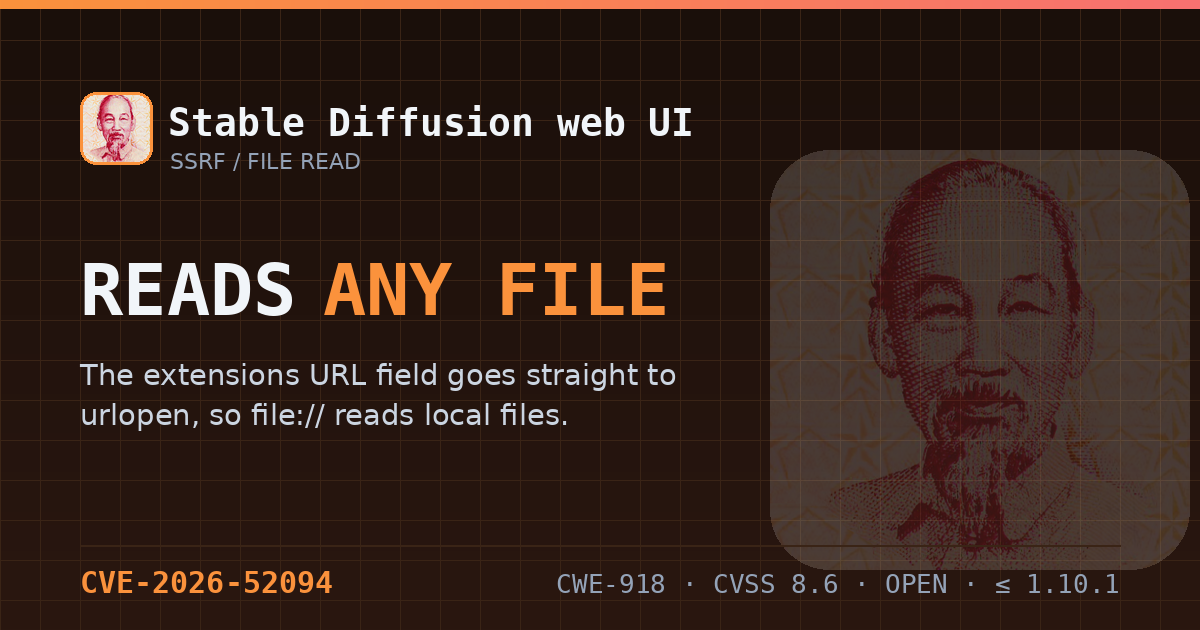
The Extensions tab in AUTOMATIC1111's Stable Diffusion web UI passes a URL field straight to urllib.request.urlopen, with no scheme check and no auth by default. file:// reads local files, http:// reaches internal services, and the result is rendered back in the UI. This is CVE-2026-52094, and the latest release is the affected version.
Reading mode
On this page
AUTOMATIC1111's Stable Diffusion web UI is one of the most widely run local image-generation tools. It has an Extensions tab, and that tab has a text field for the URL of an extensions index. Whatever you type there goes almost directly to Python's urlopen, and urlopen is happy to open more than web pages.
TL;DR: The "available extensions index" URL field is passed straight to urllib.request.urlopen with no scheme validation and, in a default install, no authentication. A file:// URL reads arbitrary local files. An http:// URL reaches internal services and cloud metadata endpoints. The response is parsed as JSON and shown in the UI, so whatever comes back is handed to the attacker. The latest release, v1.10.1, is the affected version. There is no newer fix, the project is unmaintained, and it offers no security channel to report through.
Product | Stable Diffusion web UI ( |
Affected | 1.10.1 and earlier (1.10.1 is the latest release; master is identical) |
Fixed | Not fixed |
Identifier | CVE-2026-52094 · CWE-918 (Server-Side Request Forgery), CWE-73 (External Control of File Name or Path) · CVSS 3.1 score 8.6 ( |
Disclosure note
There was nowhere to report this. The repository has no SECURITY.md and no security.txt, and GitHub's private vulnerability reporting is turned off for it, so there is no private channel to send a report to. The project is also effectively unmaintained: the last commit was in March 2026, and the issue tracker sits at a few thousand open items. With no way to reach a maintainer privately and no sign that reports get read, I am publishing directly so that operators still running it understand the risk. The CVE is worth filing because the current release is affected and there is no fix to wait for.
The sink
The whole bug fits in a few lines. In modules/ui_extensions.py, current source:
def refresh_available_extensions(url, selected_tags, showing_type, filtering_type, sort_column):
    global available_extensions
    import urllib.request
    with urllib.request.urlopen(url) as response:   # user-controlled url, no scheme check
        text = response.read()
    available_extensions = json.loads(text)
url comes from the Gradio text input for the extensions index, which the user controls. It is handed to urlopen with no check on the scheme and no check on where it resolves. By default the web UI runs without authentication, because --gradio-auth is off unless you set it, so there is no login in front of this either.
urlopen honors more than http and https. A file:// URL reads a local file. An http:// URL to an internal address reaches whatever is listening there. And because the response is read back and rendered in the UI, you do not just blindly trigger the request, you get the contents.
What it gives an attacker
Point the field at file:///etc/passwd, or at a config file, or at credentials on disk, and the web UI reads them for you. Point it at http://169.254.169.254/latest/meta-data/ on a cloud host and it fetches instance metadata, which often includes credentials. Point it at an internal service that trusts the network and you can reach it from outside. The fetched JSON is surfaced in the interface, so this is a read primitive with output, not a blind one.
Static analysis is enough to be sure here, because there is nothing conditional about it. A user-controlled string reaches urlopen directly. A container only re-demonstrates behavior that urlopen is documented to have.
What a fix would look like
Restrict the allowed schemes to http and https before calling urlopen, so file:// and friends are rejected. Validate that the target does not resolve to loopback, link-local (169.254.0.0/16), or private ranges, and do not follow redirects into those. And require authentication for the extension-index fetch so it is not reachable on an unauthenticated instance.
If you run it now
Do not expose the web UI to any network you do not control, and turn on authentication if you must run it. Because the project is unmaintained and has no security channel, treat this as a won't-fix: no patch is coming. Keep the instance off any untrusted network, and if you let other users manage extensions, assume the extensions-index field is an arbitrary-file-read primitive.
CVE-2026-52094. Stable Diffusion web UI 1.10.1 and earlier. Not fixed. CWE-918. CVSS 8.6.