Superuser by default: unauthenticated RCE in Langflow (CVE-2026-52091)
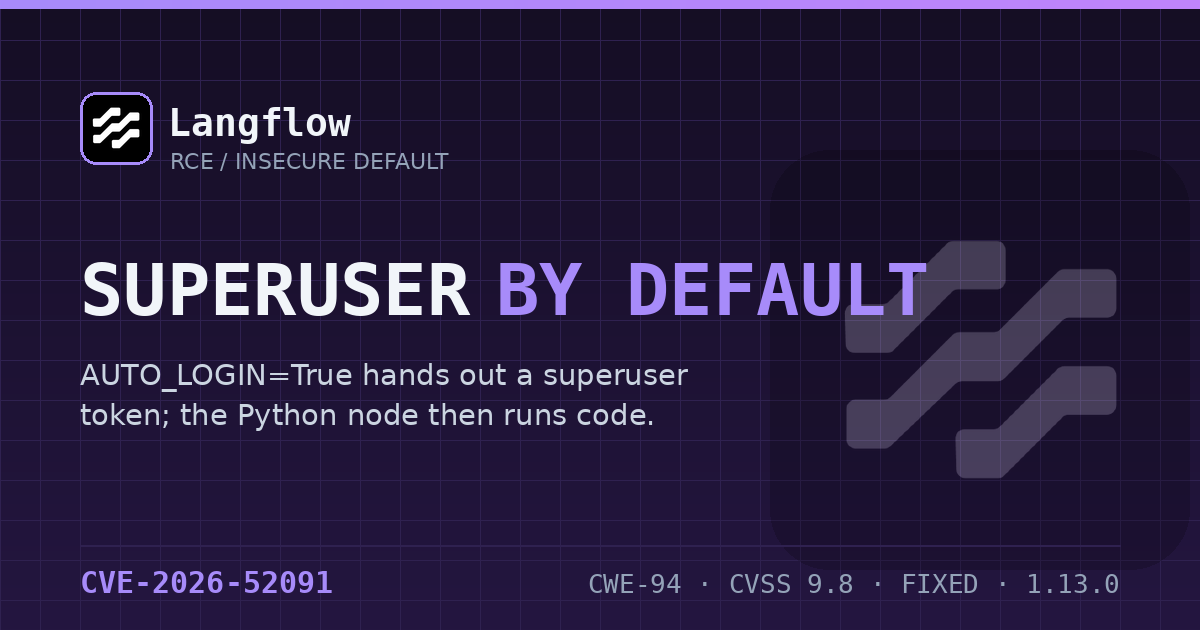
Langflow shipped with LANGFLOW_AUTO_LOGIN=True, which handed a superuser token to anyone who asked. Pair that with a Python node that runs code, and an unauthenticated stranger gets remote code execution. This is CVE-2026-52091, closed across v1.10.1 and v1.13.0.
Reading mode
Langflow is an open-source visual builder for LLM apps and agents. You drag nodes onto a canvas, wire them together, and expose the result as an API. Two of its defaults turned out to be a bad combination: it logged you in as a superuser without asking, and one of its built-in nodes ran Python. Put those together and a stranger on the network gets code execution on your server.
TL;DR: With the shipped default LANGFLOW_AUTO_LOGIN=True, Langflow issued a superuser JWT to anyone who hit /api/v1/auto_login, no credentials required. From there you mint an API key, build a flow that contains the Python REPL node, and run it. That is unauthenticated remote code execution. The code-execution half was sandboxed in v1.10.1, and the auto-login default was flipped to False in v1.13.0.
Product | Langflow ( |
Affected | 1.12.0 and earlier (default auto-login); code-execution sink before 1.10.1 |
Fixed | 1.10.1 (Python node sandboxed), 1.13.0 (auto-login defaults to False) |
Identifier | CVE-2026-52091 · CWE-94 (Improper Control of Generation of Code), CWE-1188 (Insecure Default) · CVSS 3.1 score 9.8 ( |
Timeline
2026-09-28: The unsandboxed Python node was published as GHSA-8qpj-27x8-pwpq and fixed in 1.10.1.
v1.13.0: The LANGFLOW_AUTO_LOGIN default changed from True to False. Verified in source.
2026-11-08: This writeup, which ties the two halves together as the full unauthenticated chain.
Two halves: an open door and a loaded gun
On its own, each piece is a known quantity. Auto-login is a developer convenience so you do not have to set up accounts while building locally. The Python node is a feature, because people genuinely want to run their own code inside a flow. The problem is what happens when both are on by default and the server is reachable.
The open door is the default. In src/lfx/src/lfx/services/settings/auth.py, AUTO_LOGIN was defined like this through v1.12.0:
AUTO_LOGIN: bool = Field(
    default=True,  # TODO: Set to False in v2.0
    ...
)
With that on, the /api/v1/auto_login endpoint returns a superuser JWT to an unauthenticated caller. No login screen, no password, just a token that owns the instance.
The loaded gun is the PythonREPLComponent, which runs user-supplied Python through LangChain's PythonREPL without effective sandboxing. An authenticated user who can edit and run a flow can therefore run arbitrary code on the host. That is the exact issue GHSA-8qpj-27x8-pwpq describes, rated 9.9 on its own.
The chain
Neither half needs anything clever. You just walk through them in order:
Request /api/v1/auto_login and receive a superuser JWT (because AUTO_LOGIN is True).
Use that token to create an API key through /api/v1/api_key/.
Create a flow containing the PythonREPLComponent with your Python in it.
Run the flow through /api/v1/run/<flow_id>. Your code executes on the server.
The result is full container compromise from an unauthenticated start, which is why the chain scores 9.8.
The fix
The two halves were closed in two releases. The Python node was sandboxed in v1.10.1, with further hardening through v1.12.3. The unauthenticated entry point was closed in v1.13.0, where the same field now reads:
AUTO_LOGIN: bool = Field(
    default=False,  # TODO: Set the development default to False in v2.0.
    ...
)
I checked this across tags to be sure: v1.9.2, v1.10.1, v1.11.0, and v1.12.0 all default to True, while v1.13.0 and v1.13.1 default to False. So on a current release, neither half works out of the box. The node is sandboxed and the superuser token is no longer handed out.
One loose end worth noting: GHSA-8qpj-27x8-pwpq was published with "No known CVE." CVE-2026-52091 can be associated with it so the record is complete.
Remediation
Upgrade to v1.13.0 or later, which gives you both the sandbox and the safe default. If you cannot upgrade yet, set LANGFLOW_AUTO_LOGIN=False explicitly and make sure you are at least on v1.10.1 so the Python node is sandboxed. Either way, do not expose a Langflow instance to an untrusted network while auto-login is on.
CVE-2026-52091. Langflow 1.12.0 and earlier. Fixed in 1.10.1 and 1.13.0. CWE-94. CVSS 9.8.