Unauthenticated by default: running Flowise chatflows without a key (CVE-2026-52098)
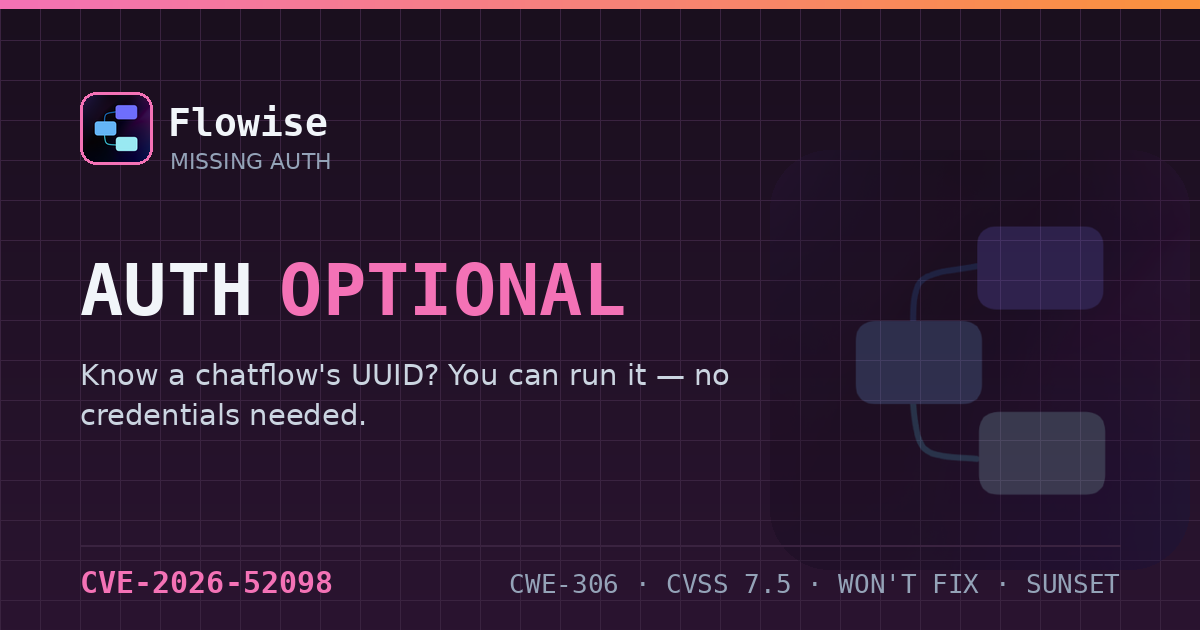
By default a Flowise chatflow has no API key, and the prediction endpoint skips authentication. So anyone who can reach the server and knows a flow's UUID can run it. This is CVE-2026-52098, confirmed on 3.1.4, in a product the vendor has now sunset with no fix coming.
Reading mode
On this page
Flowise is a widely used low-code builder for LLM apps and agents. You wire up a "chatflow" in a visual editor and expose it over an HTTP API. This isn't a coding mistake. It's a default. Two reasonable design decisions, put together, leave the endpoint that actually runs your flows open to anyone who can reach it.
TL;DR: By default, a Flowise chatflow has no API key, and the prediction endpoint (/api/v1/prediction/<flowId>) is left out of the global authentication middleware. So an unauthenticated caller who can reach the server and knows a chatflow's UUID can run that flow, even on instances where app login is turned on. Flowise has been sunset and is not accepting security reports, so no fix is coming. The fixes here are all on the operator.
Product | Flowise ( |
Affected | 3.1.4 and earlier (all current releases) |
Fixed | None (project sunset) |
Identifier | CVE-2026-52098 · CWE-306 (Missing Authentication for Critical Function), CWE-1188 (Insecure Default) · CVSS 3.1 score 7.5 ( |
Disclosure note
Normally this section would be a coordinated-disclosure timeline. There can't be one. The vendor has publicly retired Flowise and says it is no longer taking security reports. With no one upstream to coordinate with, I'm publishing directly so that operators still running it can defend themselves. I confirmed the behavior on the current code (3.1.4) and dynamically on 3.1.2 on 2026-11-06, and published this on 2026-11-08.
Background: two decisions that are fine apart
Flowise has an optional app login (set FLOWISE_USERNAME and FLOWISE_PASSWORD). It also has a deliberately public prediction API, because chatbots are meant to be embedded in web pages and called by anonymous users. To make that work, two things are true. The prediction route is allowlisted past the global authentication middleware. And per-chatflow protection is opt-in: you attach an API key to a chatflow, and callers have to present it.
Each decision is fine on its own. The trouble is the way the allowlist combines with the default state of a new chatflow.
Root cause
First, the allowlist. /api/v1/prediction/ sits in WHITELIST_URLS (packages/server/src/utils/constants.ts), which the global auth middleware skips:
export const WHITELIST_URLS = [
    ...
    '/api/v1/prediction/',   // skipped by global authentication
    ...
]
So reaching the prediction endpoint never triggers the app login check. The protection that is supposed to take over is the per-flow key, in validateFlowAPIKey (packages/server/src/utils/validateKey.ts):
export const validateFlowAPIKey = async (req, chatflow) => {
    const chatFlowApiKeyId = chatflow?.apikeyid
    if (!chatFlowApiKeyId) return true   // no key assigned, so allowed
    ...
}
Here is the hinge. When a chatflow has no API key, chatflow.apikeyid is null and the function returns true, meaning authorized. And apikeyid is null for every newly created chatflow. The column is nullable, and nothing fills it in unless you go into the UI and assign a key. The secure setup exists, but you have to opt into it, and the out-of-the-box state of any flow is "no credentials required."
In practice this bites the operator who turns on Flowise's login, assumes the instance is locked down, builds a few chatflows, and never realizes that the endpoint running those flows, and spending the money, ignores that login.
Confirming it, not just reading it
I ran Flowise in Docker (version 3.1.2; the relevant code is identical in the current 3.1.4), with app login enabled, and sent requests with no credentials.
First, check that login is actually on by hitting normal, non-allowlisted endpoints:
GET  /api/v1/chatflows     ->  401 Unauthorized
GET  /api/v1/credentials   ->  401 Unauthorized
Good, the app turns away unauthenticated requests. Now the allowlisted prediction endpoint, still with no credentials, against a random flow ID:
POST /api/v1/prediction/<random-uuid> -> 404 {"message":"Chatflow 'random-uuid' not found..."}
That 404 is the tell. A 401 would mean the auth layer stopped the request at the door. Instead the request went past authentication and into the handler, which then couldn't find a chatflow with that ID. For this route, there was no door.
Last, the full chain. I inserted a chatflow whose apikeyid is NULL (the default) and hit its prediction endpoint, still with no credentials:
POST /api/v1/prediction/<real-id-with-null-apikeyid> -> 400 {"message":"Invalid Chatflow ID"}
Again, not a 401, and not an API-key error. The request cleared the authentication middleware and validateFlowAPIKey (a null key returns true) and reached flow processing. It only errored because my test flow had no model node wired up. On a real, populated chatflow, that last step is your flow running on an attacker's input.
Impact
Anyone who can reach the instance and knows a chatflow's UUID can trigger this, with no login and no key. What they get is the ability to run your chatflows. In practice that means your LLM bill paying for their prompts, which is a direct financial denial of service if a flow calls a paid model, plus resource exhaustion and exposure of your flow logic and any data a flow handles or returns.
To be fair about severity: Flowise sandboxes flow execution, so this is not a clean remote-code-execution bug. That is why integrity and availability carry the score, and the confidentiality part is about flow data, not the host.
I will state the counter-argument plainly, because the maintainers would. They consider the prediction API public by design, and a comment in the source even says "Prediction/Upsert API is public." My view is that "public endpoint" and "no authentication needed to run a flow that costs money, by default" are two different claims. The second one is worth a CVE, so operators can decide for themselves instead of inheriting the assumption.
Remediation (there is no patch)
Flowise is retired and not accepting security reports, so every control here is yours to put in place.
Put Flowise behind a reverse proxy that enforces authentication on every path, including /api/v1/prediction/, and never expose it directly to a network you do not trust. That is the most important one. Assign an API key to every chatflow so validateFlowAPIKey actually checks something, and audit the flows you already have, because the default is no key. Treat chatflow UUIDs as semi-secret identifiers, not as a security boundary, since the proxy is the boundary. And start planning a move off Flowise, because a retired product with a known, won't-fix default-exposure issue is not something to keep building on.
If you are running Flowise today, the short version is: get it behind real authentication now, and put "migrate off Flowise" on the roadmap.
CVE-2026-52098. Flowise 3.1.4 and earlier (project sunset, no fix). CWE-306 and CWE-1188. CVSS 7.5.